

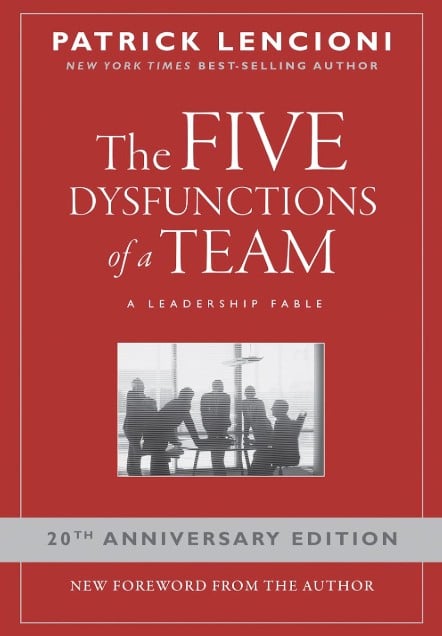
The story opens with Kathryn Petersen taking over as CEO of DecisionTech, a startup that has every possible advantage on paper: funding, talent, and early hype. Despite that “luck,” the company is struggling badly. Lencioni uses this contrast to make the point that external conditions and raw talent are not enough. The real issue is that the senior team does not behave like a team, and that invisible problem is rotting everything else.
In this part, we see how DecisionTech drifted from early promise into stagnation. The executives avoid real collaboration, operate in silos, and quietly undercut one another. Meetings are full of vague updates instead of decisive conversations, so execution stalls and people disengage. Kathryn’s main insight is that the disappointing results are symptoms, not the disease: the disease is a leadership group that will not work together.
Kathryn begins to confront the team directly and names teamwork as the primary strategic problem. She introduces the five dysfunctions model and explains that without fixing these behavioral issues, no amount of strategy or restructuring will matter. Some executives bristle, others retreat, and tension rises, which is exactly what she wants. This section shows the first spark: a leader willing to tell the truth about behavior and insist that it change.
Here the team starts doing the hard work of change. They run vulnerability exercises, admit mistakes, and begin to challenge each other more openly in meetings. It is messy: feelings get hurt, old habits resurface, and several people consider leaving rather than adapting. Kathryn keeps pulling them back to the model, reminding them that trust, conflict, commitment, accountability, and results are skills that must be practiced, not slogans to nod at.
Over time, the new habits begin to stick. The team debates real issues instead of avoiding them, makes clear decisions, and follows through. People start calling each other out on missed commitments without waiting for the CEO to referee. As they do, results improve, morale lifts, and DecisionTech finally starts to act like the high potential company everyone expected in the first place. Traction is the payoff: visible performance gains that come directly from better teamwork.
In the final section, Lencioni steps out of the fable and lays out the five dysfunctions as a practical framework. Absence of trust sits at the base, feeding fear of conflict, which leads to lack of commitment, then avoidance of accountability, and finally inattention to results at the top. He explains diagnostic questions, simple exercises, and leader behaviors for each layer, and makes it clear that you build the pyramid from the bottom up. The message is blunt: if you want a high performing team, you have to treat these five areas as daily work, not a one time workshop.
The Five Dysfunctions of a Team is really a book about why smart, well funded, highly skilled groups still fail to perform. Lencioni argues that the problem is almost never strategy or talent, it is the invisible habits that shape how people behave together. He presents teamwork as a true competitive advantage: if a leadership team can learn to trust one another, argue productively, commit clearly, hold each other accountable, and stay focused on shared results, it can outperform far “smarter” competitors. The fable about DecisionTech is just the vehicle he uses to make those dynamics feel real instead of theoretical.
At the core of the book is a simple pyramid model. At the base is absence of trust, where people hide weaknesses and avoid vulnerability. That drives a fear of conflict, so meetings stay polite on the surface while the real issues never get aired. When people do not debate honestly, they never fully buy in, which creates lack of commitment. Without real commitment, teammates avoid holding one another accountable, and in the end everyone drifts toward personal status or silo goals instead of collective results. The five dysfunctions stack on each other, so if you ignore the lower layers, you cannot fix the ones above.
Lencioni’s solution is not theory, it is practice. Leaders have to go first by admitting mistakes, sharing their own histories, and inviting feedback so real trust can form. They must encourage and even provoke healthy conflict around ideas, then drive decisions to clarity: who will do what, by when, with no ambiguity. From there, the team agrees on shared goals and concrete standards, and gives explicit permission for peers to call each other out when those standards slip. Metrics and shared scoreboards keep everyone focused on the same finish line.
The book closes with tools and guidance on how to do this for real: simple exercises to build vulnerability based trust, ways to normalize conflict rules, methods to create clear commitments in meetings, and routines that make peer accountability normal instead of awkward. The main message is that teamwork is a deliberate choice, not something that appears because you hired good people. If a team is willing to be uncomfortable for a while, it can turn the five dysfunctions into five strengths and unlock performance that looks almost impossible from the outside.