
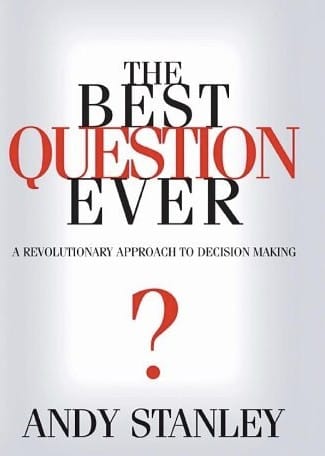
The Best Question Ever

by Andy Stanley
Chapter Summaries
Full Summary​

The Best Question Ever argues that most regrettable decisions in life come from asking the wrong questions. People usually evaluate choices by asking whether something is technically allowed, morally acceptable, or not overtly harmful. Stanley explains that this approach leads people to live near the edge of danger and then act surprised when they fall. Instead of asking what is permissible, he proposes one clarifying filter for every decision: What is the wise thing to do, in light of my past experiences, my present circumstances, and my future hopes and dreams? This question reframes choices around long-term clarity rather than short-term convenience and exposes self-deception that often drives poor judgment.

Stanley shows how this single question applies to time, money, relationships, and moral boundaries. He emphasizes that unwise decisions rarely feel dramatic in real time. They usually grow from small compromises, rushed impulses, and the belief that we are the exception to the rule. By using wisdom as a filter, people gain the ability to see consequences before they arrive and avoid situations that lead to predictable regret. The book argues that wise choices expand freedom, prevent emotional and financial stress, and create a foundation for a more stable future.

A major theme is self-awareness. Stanley stresses that people must recognize their own patterns before they can choose wisely. A choice that seems harmless for one person may be dangerous for another because wisdom is highly personal. The question also forces people to consider their aspirations and decide whether their daily habits support or sabotage the life they want. This builds intentionality and protects against the common tendency to react rather than plan.

Stanley concludes by grounding wisdom in spiritual life. True clarity comes not just from better decision filters but from cultivating a relationship with God, who provides direction, purpose, and accountability. The book encourages readers to invite trusted people into their decision-making process, to challenge their blind spots, and to create environments where wisdom grows naturally. The Best Question Ever ultimately provides a simple but powerful tool for building a life marked by fewer regrets and greater alignment between choices and values.

  • #1 Wisdom is a higher standard than legality or permission. Many choices in wealth planning are technically allowed but still unwise. The book’s core idea reinforces that the right question is not “Is this okay?” but “Is this wise?” For stewards responsible for long-term financial clarity, this means avoiding strategies that look clever in the moment but undermine stability over time.
  • #2 Your past shapes your risks. Personal history is one of the strongest indicators of future behavior. Patterns in spending, investing, relationships, and decision-making reveal where individuals are most vulnerable. EWA’s planning philosophy mirrors this idea by using self-awareness to ensure people do not repeat avoidable mistakes.
  • #3 Every season requires tailored decisions. Wisdom is contextual. A decision that works during early-career growth may not work during family expansion or legacy planning. This matches EWA’s commitment to evolving strategies that reflect changing responsibilities, ambitions, and financial structures.
  • #4 The future must guide today’s choices. Long-term goals should determine current actions. In wealth management, this applies to investment compounding, estate design, risk posture, and even family governance. Each step should support the future life and legacy a family wants to build.
  • #5 Questions create clarity. Simply asking “What is the wise thing to do?” introduces calm, structure, and discipline. It prevents reactive choices in moments of pressure. Families can use this question as a shared decision filter, improving both financial and relational decisions.
  • #6 Guardrails prevent regret. Most financial missteps and personal regrets could have been avoided with one moment of reflection. At EWA, decision frameworks function as guardrails that protect wealth from emotional reactions, impulsive moves, and preventable mistakes.
  • #7 Cultural pressure is not a strategy. Popular trends often encourage behavior that is financially unstable. Families building durable wealth must make choices based on principles, not the habits of peers. Wisdom often requires choosing differently than the culture around you.
  • #8 Wisdom compounds like wealth. Just as consistent investing creates exponential financial growth, consistent wise decisions create exponential life clarity. Over time, a pattern of wisdom becomes one of the most valuable assets a family can pass down.
  • #9 Discipline outweighs impulse. The discipline to pause, evaluate, and choose intentionally matters far more than temporary excitement or fear. This reflects EWA’s philosophy that long-term planning always outperforms short-term reaction.
  • #10 A family culture of wisdom creates impact. Embedding the wise-question framework into family conversations, decisions, and planning ensures that financial success is joined by shared values. This produces intergenerational stewardship, stability, and purpose.