

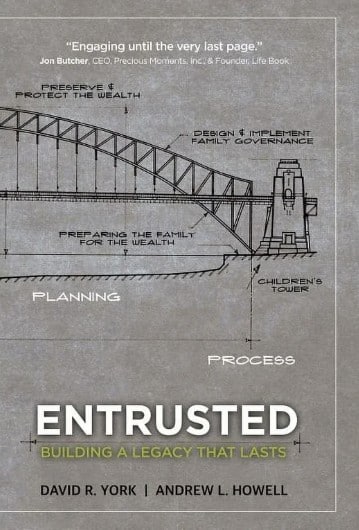
York and Howell begin by describing the VUCA environment surrounding modern estate planning. Family structures are more complex, laws shift frequently, and massive wealth transfers are underway. Traditional planning focuses on assets, taxes, and tools, often using generic, one size fits all plans that ignore family dynamics and human capital. This “dump, divide, defer, and dissipate” model leads to conflict, entitlement, and rapid loss of wealth. The authors argue for a shift toward entrusted planning, which aims for stability, certainty, simplicity, and clarity by focusing on people and purpose first.
The first discipline is clarity of identity. Entrusted families can articulate who they are, what they value, and what they stand for. York and Howell emphasize four pillars: values, vision, relationships, and resources. Values form the foundation, vision gives direction, relationships hold the family together, and financial resources support the mission rather than define it. This clarity unifies the family, guides planning decisions, and helps advisors align technical work with the family’s core beliefs.
Here the authors stress that the real work of planning is preparing beneficiaries, not just polishing legal structures. Entrusted families focus on education, character, responsibility, and financial literacy. They set clear expectations, respect individuality, and emphasize equal opportunity rather than guaranteed equal outcomes. The goal is to raise capable stewards who can manage and grow resources, rather than to shield heirs with structures they are not ready to handle.
York and Howell distinguish between holistic wealth and financial wealth. Holistic wealth includes intellectual, social, and spiritual capital alongside money. As financial capital grows, its potential to amplify either positive or negative outcomes also grows. Entrusted families intentionally use wealth to expand opportunity, education, service, and impact, while limiting the risk of dependence, idleness, or value drift. They identify a “high point” of beneficial inheritance and redirect excess toward opportunities or social impact rather than unchecked consumption.
This chapter introduces the flint and kindling metaphor. Flint represents human capital, such as skills, work ethic, experience, and character. Kindling represents limited financial support that helps ignite those abilities, such as education funding, seed capital, or a down payment. The “fire” is the visible wealth or success that results. Traditional planning focuses on the fire by handing over large sums. Entrusted families focus on flint and kindling, trusting that given tools and opportunity, future generations can and should create their own fire.
York and Howell describe generosity as a unifying force. Entrusted families cultivate generosity in time, resources, and attention, not only through charitable giving but also through service and shared projects. Working together on generosity bridges generational gaps and strengthens relationships. It shifts focus away from self and consumption toward contribution and shared purpose, reducing entitlement and deepening gratitude.
This discipline addresses the practical threats to multigenerational wealth: division among heirs, taxes, business risks, and third party claims. Entrusted families use appropriate legal and financial tools to guard against these forces, but always in service of their purpose and values. Preservation is not about hoarding or fear, but about protecting the family’s mission and giving future generations a stable platform from which to build.
Governance is presented as the structure through which a family makes decisions, resolves conflicts, and transitions leadership. Entrusted families create forums and processes that allow younger generations to participate while elders are still present to mentor them. Governance is dynamic, adapting as the family and its circumstances change. The emphasis is on communication, accountability, and shared responsibility rather than control.
In the final chapter, York and Howell outline a practical process for putting entrusted planning into action. Families clarify their identity and purpose, assess their existing planning, engage in structured conversations, and work with advisors to design or revise legal and financial structures that reflect the seven disciplines. The process is ongoing, with regular reviews and updates as the family grows and changes. The ultimate goal is to move from generic, asset focused planning to a living, relational plan that prepares entrusted, not entitled, beneficiaries.
Entrusted by David R. York and Andrew L. Howell argues that traditional estate planning is failing many families. The usual model of “dump, divide, defer, and dissipate” focuses almost entirely on financial capital and tax tools. It treats planning as a technical transaction, ignores the people who will receive the wealth, and often results in conflict, entitlement, and the familiar pattern of wealth disappearing by the third generation. The authors place this in a broader VUCA context, a world that is volatile, uncertain, complex, and ambiguous, shaped by changing family structures, shifting views on inheritance, and increasingly complex laws.
In contrast, York and Howell propose “entrusted planning,” which seeks to move families toward stability, certainty, simplicity, and clarity. Entrusted planning is beneficiary focused, purpose driven, and customized. It starts not with documents or tax strategies, but with questions of identity, values, and vision. The goal is not just to transfer assets, but to prepare people, so that beneficiaries are entrusted stewards rather than entitled recipients. The authors stress that the principles a family lives by during life should match what their plan does after death. Wealth should never be allowed to do in death what the family would never encourage in life.
The core of the book is seven disciplines that characterize entrusted families. These disciplines emphasize knowing who you are, preparing the family for wealth, maximizing the positive and minimizing the negative effects of money, focusing on “flint and kindling” rather than the “fire,” cultivating generosity, preserving and protecting wealth wisely, and designing dynamic governance that evolves over time. The metaphor of flint and kindling captures the central theme: wealth should provide tools and opportunities, not finished outcomes. The focus is on building character, capability, and opportunity rather than engineering equal results.
Entrusted planning is presented as an ongoing process, not a one-time event. Families are encouraged to develop clear statements of values and purpose, build education and communication habits, create flexible structures and governance, and revisit their plans as people and circumstances change. The book ultimately reframes estate planning as a relational and multigenerational endeavor. It is less about legal documents and more about aligning people, purpose, and resources so that wealth becomes a catalyst for growth, contribution, and a legacy that genuinely lasts.