

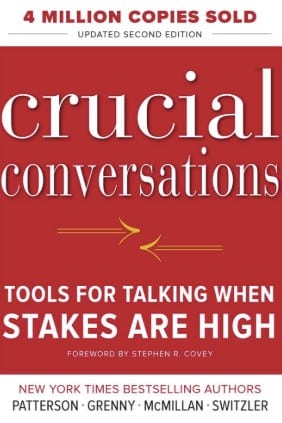
The authors define a crucial conversation as one with high stakes, differing opinions, and strong emotions. They show how people typically respond with silence or violence, either avoiding the issue or pushing aggressively. The chapter argues that success in career and relationships is heavily linked to the ability to handle these conversations well instead of dodging them.
This chapter introduces dialogue as the core skill. Dialogue means everyone freely shares their ideas so a pool of shared meaning can form, which leads to smarter decisions. The authors explain that the goal is not to win arguments but to keep everyone contributing to this shared pool.
Here the focus is on managing yourself before managing the conversation. The authors show that under stress people lose sight of what they truly want and start trying to win, punish, or avoid. They suggest asking questions like “What do I really want for me, for them, and for this relationship?” and then acting in ways that match those answers.
This chapter teaches readers to notice early signs that a conversation is becoming unsafe. Clues include people going silent or becoming sarcastic, defensive, or hostile. The skill is to step out of the content long enough to ask whether mutual purpose or mutual respect is threatened, then address safety before returning to the topic.
The authors explain that people only stay in dialogue when they feel respected and believe their goals matter. When safety breaks down, the remedy is to rebuild mutual purpose and mutual respect. Tools include apologizing when appropriate, using “contrasting” statements to clarify intent, and working together to find a shared objective.
This chapter explores how emotions are driven by the stories we tell ourselves about what we see. The authors describe three common “clever stories”: victim, villain, and helpless stories, which justify unhelpful reactions. They teach readers to return to the facts, question their interpretations, and replace these stories with more complete ones that allow for calmer, more constructive responses.
Here the focus shifts to sharing your own view. The STATE model guides this: share the facts first, tell your story about those facts, ask for others’ views, talk tentatively, and encourage testing of ideas. The goal is to be clear and honest while still inviting others into the conversation rather than pushing them into defensiveness.
This chapter provides tools for drawing out other people when they are emotional or guarded. Using the AMPP skills, ask, mirror, paraphrase, and prime, the listener shows genuine interest and helps others feel safe to explain their perspective. The aim is to understand how they moved from what they saw to the conclusions they reached.
Once a shared understanding exists, the conversation must lead to clear decisions. The authors describe different decision methods, such as command, consult, vote, and consensus, and stress the importance of deciding who will do what by when. They highlight the need for follow-up so that agreements become real actions instead of vague intentions.
This chapter offers a preparation checklist for upcoming crucial conversations. Readers are encouraged to clarify their goals, anticipate safety risks, plan how to start, and review the key skills. It also emphasizes learning from past conversations by reflecting on what went well and what did not.
The authors address common objections, such as dealing with someone who will not listen, handling authority figures, or confronting long-standing problems. They show how the same principles still apply, but may need extra patience, more work on safety, or repeated attempts. The chapter reinforces that there are practical ways to apply the model even in difficult real-world situations.
The final chapter focuses on implementation. The authors suggest starting with one or two relationships or situations, practicing the skills, and seeking feedback. Over time, using these tools consistently can reshape how a person handles conflict in all areas of life, leading to better results and stronger connections.
Crucial Conversations explains why people often do their worst when the stakes are highest and how to turn those moments into productive dialogue instead of argument or avoidance. A “crucial conversation” is any discussion where opinions differ, emotions run strong, and the outcome matters. In these situations our stress response kicks in, so we either go silent, become aggressive, or bounce between the two. The book’s central claim is that results in work, families, and communities depend heavily on how we handle these conversations.
The authors argue that the goal in a crucial conversation is not to win but to create dialogue. Dialogue means that everyone feels safe enough to share their views, so all the relevant information enters a “pool of shared meaning.” When people feel unsafe they protect themselves instead of contributing, which leads to poor decisions and damaged relationships. To prevent this, skilled communicators watch for signs that safety is at risk, then restore it by rebuilding mutual purpose and mutual respect.
A key part of the process is mastering your own stories. Before emotions erupt, you see something, tell yourself a story about what it means, then feel and act based on that story. If the story is incomplete or unfair, the emotion will be too. The book teaches readers to slow down, separate facts from interpretations, and replace victim, villain, and helpless stories with more accurate ones that keep dialogue possible.
Once safety is restored and emotions are manageable, the focus turns to how to speak and listen. The STATE model summarizes how to share a viewpoint clearly but respectfully: share the facts, tell your story, ask for others’ paths, talk tentatively, and encourage testing. On the listening side, the AMPP tools, ask, mirror, paraphrase, and prime, help others open up when they are shutting down or lashing out. Together these skills create conversations where people can be both honest and kind.
The final part of the book shows how to move from talk to results. Crucial conversations should end with clear decisions, owners, and follow-up. The authors also address “tough cases,” such as dealing with power differences, chronic bad behavior, or conversations that keep going badly, and explain how to practice these skills until they become habits. In the end, Crucial Conversations presents a practical method for turning high stakes conflict into shared understanding, better decisions, and stronger relationships.