

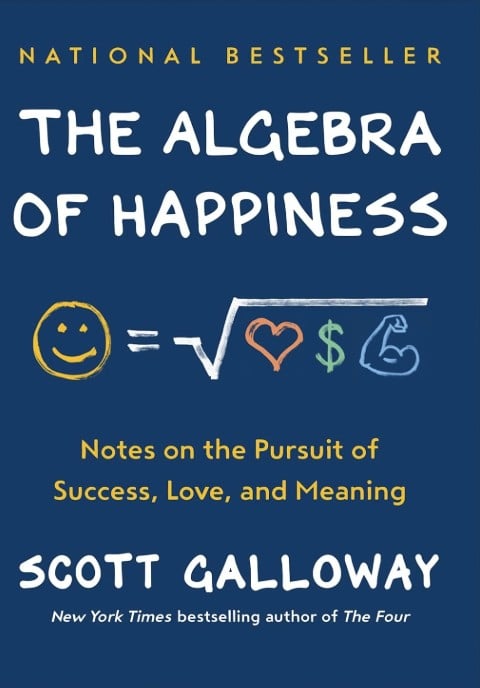
Galloway introduces the idea that while life has no perfect equation, the same variables repeatedly appear in the lives of fulfilled people. These include financial stability, strong relationships, health, and purpose. He clarifies that happiness is not constant pleasure but resilience and balance. Most people overestimate the effect of wealth and underestimate the compounding power of love and community. The introduction frames the book as a set of practical observations meant to help readers design a meaningful life.
This section explains that the first priority in early adulthood is financial security. Money does not guarantee happiness, but a lack of it consistently causes stress and limits choice. Galloway argues for disciplined saving, controlled spending, and positioning yourself in industries with upward mobility. Once stability is achieved, additional wealth brings smaller returns, and continued workaholism often harms relationships and health. Success is defined as autonomy rather than accumulation. Galloway encourages readers to balance ambition with perspective so they do not reach the top alone.
Galloway argues that relationships are the strongest predictor of long-term happiness. Romantic partnerships, family bonds, and friendships require steady investment and emotional maturity. Choosing the right partner is essential because compatibility multiplies joy, while the wrong match amplifies stress. He reminds readers that career achievements feel empty without someone to share them with. Love thrives through generosity, forgiveness, and presence, and it deteriorates when ego overrides connection.
Health is described as the non-negotiable base of a good life. Without physical and mental well-being, wealth and relationships cannot be fully experienced. Galloway encourages consistent exercise, adequate sleep, and routines that support long-term vitality. He normalizes therapy and emotional openness, explaining that mental health requires the same discipline as financial health. This section reinforces that decisions about the body and mind compound over decades and shape the quality of life more than any single achievement.
The epilogue distills the book into a simple concept: a meaningful life requires balance among money, relationships, health, and purpose. Galloway concludes that happiness is built through consistent actions, not dramatic breakthroughs. Saving, exercising, nurturing relationships, and expressing gratitude are small decisions that accumulate into fulfillment. He encourages readers to live intentionally, focus on what endures, and invest energy into the people and habits that give life depth.
The Algebra of Happiness explores the variables that consistently shape a fulfilling life. Scott Galloway argues that although happiness cannot be reduced to a perfect formula, there are reliable patterns that determine long-term well-being. These include financial stability, meaningful relationships, physical and mental health, and a life anchored in purpose. Galloway blends data, personal experience, and practical advice to show how small daily choices compound into a life of meaning.
He emphasizes that early career years are best used for disciplined work, controlled spending, and investing in skills that increase long-term freedom. Money matters, especially in youth, because financial security reduces stress and widens opportunity. However, he warns that chasing wealth beyond stability produces diminishing returns and often damages relationships. Real success is the ability to control your time, not the pursuit of external validation.
Galloway places deep importance on love and connection. Strong relationships bring the highest returns on happiness. He insists that partnership requires generosity, effort, and emotional maturity, and that investing in family and friends produces joy more reliably than any career milestone. Without people to share life with, professional achievements lose meaning.
Health is presented as the foundation of a good life. Daily exercise, sleep, and mental stability create the capacity to enjoy wealth and relationships. Neglecting health undermines every other variable in the equation. Galloway urges readers to treat their bodies and minds with long-term discipline.
Ultimately, Galloway argues that happiness comes from alignment: working toward financial stability without sacrificing relationships, striving for success without losing integrity, and maintaining ambition while caring for physical and emotional well-being. Happiness is not a single choice. It is the product of thousands of decisions made with intention, clarity, and perspective.