

Chapter 1 explains why modern leadership requires deeper psychological awareness. The workplace demands adaptability, emotional intelligence, and relational skill. Understanding one's Enneagram type allows leaders to see habitual patterns that affect communication, decision making, and team dynamics. By becoming aware of their automatic reactions, leaders begin to operate from conscious choice instead of reactivity.
This chapter introduces the nine Enneagram types, describing their core motivations, fears, and behavioral patterns. Chestnut emphasizes that the Enneagram goes beyond traits. It uncovers internal drivers that shape leadership style. The chapter establishes the Enneagram as a growth tool that helps leaders identify blind spots and leverage strengths across daily interactions.
Chapter 3 details how leaders can apply Enneagram insights to personal development and organizational performance. Self-observation, feedback, and reflective practices help leaders interrupt ineffective habits. On a broader scale, the Enneagram improves communication, conflict management, and talent development by helping teams understand each member's psychological wiring.
Type One leaders prioritize integrity, standards, and quality. They excel in improving processes and maintaining discipline. However, the internal pressure for perfection can create rigidity or criticism. Growth involves accepting imperfection, delegating more comfortably, and balancing rules with flexibility to adapt to real-world constraints.
Type Two leaders derive motivation from helping others and building strong relationships. They cultivate collaboration and morale. Their challenge is overextending themselves or tying their value to being needed. Effective growth comes from setting boundaries, acknowledging personal needs, and leading with balanced support rather than overinvolvement.
Type Three leaders focus on achievement, results, and efficiency. They inspire ambition and drive organizational momentum. Their blind spot is overidentifying with success and prioritizing image over authenticity. Growth requires slowing down, accessing genuine feelings, and pursuing goals aligned with deeper values rather than external validation.
Type Four leaders bring emotional insight, creativity, and depth. They value authenticity and meaningful work. The challenge is a tendency toward emotional intensity and withdrawal when misunderstood. Growth means grounding themselves in the present, regulating emotions, and contributing their creativity without getting lost in internal narratives.
Type Five leaders excel in analysis, strategy, and independent thinking. They accumulate expertise and remain calm under pressure. However, detachment and emotional distance can limit connection with teams. Growth involves engaging more openly, sharing knowledge generously, and reentering collaborative environments instead of retreating into isolation.
Type Six leaders anticipate problems, assess risks, and provide reliability in uncertainty. Their loyalty and preparation strengthen organizations. The challenge is chronic doubt, overanalysis, and hesitancy. Growth requires trusting their judgment, developing confidence in others, and acting despite discomfort rather than waiting for perfect certainty.
Type Seven leaders generate ideas, inspire enthusiasm, and see possibilities. They thrive in innovation and rapid ideation. Their struggle is avoidance of discomfort, distraction, and difficulty with follow-through. Growth involves staying grounded, embracing limits, and developing discipline to execute ideas instead of initiating endless new ones.
Type Eight leaders are bold, protective, and action oriented. They excel in crisis and naturally command authority. The risk is coming across as intimidating or controlling. Growth means practicing vulnerability, listening more openly, and inviting collaboration rather than overpowering others. Their leadership becomes stronger when tempered with empathy.
Type Nine leaders create harmony, stability, and cohesion. They see multiple perspectives and excel at mediation. The challenge is conflict avoidance, indecision, and merging with others’ priorities. Growth requires asserting their own views, setting clear direction, and engaging conflict constructively rather than retreating from it.
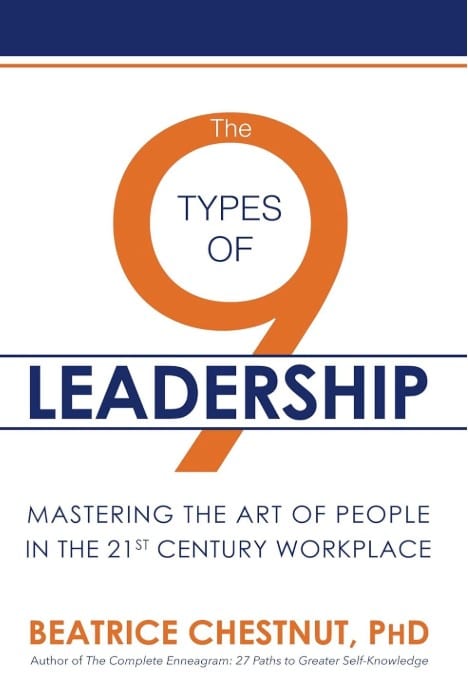
The 9 Types of Leadership by Beatrice Chestnut argues that modern leadership requires emotional intelligence, self-awareness, and a deeper understanding of human behavior. The Enneagram provides that foundation by revealing nine personality structures, each with predictable strengths, blind spots, and motivations. Chestnut frames leadership not as a one-size-fits-all skillset but as a developmental path shaped by the inner patterns each type must manage.
The book begins by recognizing that the 21st-century workplace is complex and relational. Technical competence is no longer enough. Leaders must understand the personalities of the people they guide and, just as importantly, the patterns within themselves. The Enneagram becomes a strategic tool for diagnosing interpersonal friction, improving communication, and elevating team performance. Rather than labeling people, it helps leaders observe automatic habits and choose more conscious behaviors.
Chestnut explains how each of the nine types shows up at work. Some lead by enforcing ethics and quality, others by helping, achieving, innovating, analyzing, protecting, inspiring, confronting, or harmonizing. The strengths are significant, yet the vulnerabilities matter just as much. A Type One leader can create excellence or become rigid. A Type Seven leader brings excitement or avoids focus. A Type Nine can unify or disappear into passivity. Growth requires learning to moderate these automatic tendencies.
Throughout the book, Chestnut demonstrates how teams improve when leaders understand differing motivations. Conflicts become easier to interpret. Expectations become clearer. Leaders adopt communication strategies that match the psychological needs of colleagues rather than a single default style. Organizational cultures benefit from this shared vocabulary, especially when the Enneagram becomes a neutral, nonjudgmental way to discuss behavior.
Ultimately, the book positions the Enneagram as a practical business tool. It strengthens leadership development pipelines, improves trust across teams, and supports healthier cultures. When people understand the patterns that drive their behavior, they gain the freedom to choose more effective responses. By combining psychological insight with real organizational application, Chestnut provides a framework that helps leaders expand both personal capacity and collective performance.