

Gladwell introduces the idea that success often compounds. Small early advantages create larger opportunities over time. Using Canadian hockey as an example, he shows that players born in the first months of the year are older and more physically developed, which earns them more playing time, coaching, and resources. These advantages build on themselves, revealing that structural factors, not only talent, shape who rises to the top.
Gladwell argues that mastery requires about ten thousand hours of deliberate practice. Talent matters, but sustained work over many years is what produces exceptional performers. He illustrates this through examples like The Beatles, Bill Joy, and Bill Gates, all of whom gained unusual access to opportunities that allowed them to accumulate practice hours long before they became famous. The rule challenges the myth of overnight success.
Gladwell examines the limits of raw intelligence. He shows that after a certain threshold, higher IQ offers little additional advantage. Using Lewis Terman’s study of gifted children and the story of Christopher Langan, he argues that intelligence alone does not predict success. Other forms of ability, especially practical intelligence, matter just as much.
This chapter explores how family background shapes practical intelligence. Children raised in environments that encourage questioning, negotiation, and engagement with authority learn how to navigate systems effectively. Others, despite high intelligence, may struggle without this social skill set. Gladwell contrasts Langan’s upbringing with that of Robert Oppenheimer to show how cultural capital influences outcomes.
Gladwell uses Joe Flom, a prominent lawyer, to illustrate how timing, demographic luck, and cultural heritage shape success. Flom grew up in a specific era, belonged to a minority group excluded from elite law firms, and entered the field just as corporate law was evolving. His disadvantages positioned him perfectly to seize opportunities that others overlooked.
Gladwell examines a violent feud in Harlan to explain the concept of a culture of honor. He argues that cultural legacies, even those rooted in centuries-old traditions, shape modern behavior. The patterns of aggression in Harlan were not random but inherited. This shows that success and struggle often arise from cultural backgrounds rather than individual traits.
Gladwell studies airline accidents to show how communication norms rooted in culture can contribute to disaster. In high power-distance cultures, subordinates may hesitate to speak directly to authority figures, even in emergencies. When flight crews revised communication practices, safety improved. The chapter highlights the powerful influence of cultural expectations on performance.
Gladwell connects the structure of rice farming to strong math performance in certain Asian cultures. Rice farming requires patience, precision, and relentless work, and these cultural values carry into educational habits. Gladwell argues that persistence and effort, not innate ability, explain math success across countries.
Gladwell explores educational inequality through the story of KIPP Academy. Students from low-income backgrounds often lose academic ground during long school breaks. KIPP’s extended schedule gives students more learning time, narrowing achievement gaps. Marita’s story shows that opportunity, structure, and effort can transform outcomes for children who otherwise would be left behind.
Gladwell concludes with his own family history to illustrate his central argument. Success is never purely individual. It emerges from cultural heritage, timing, opportunity, and accumulated advantages. Small choices and historical currents shaped his life, underscoring that achievement is rooted in context as much as personal talent.
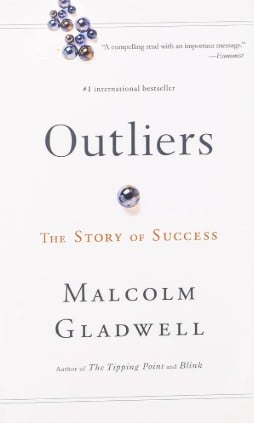
Outliers challenges the popular belief that success is the product of individual talent and determination. Gladwell argues that achievement is deeply shaped by external factors such as birthdate, cultural background, family circumstances, and historical timing. He illustrates this through striking examples, beginning with Canadian hockey players whose birth months confer hidden advantages. These advantages accumulate through better coaching and opportunities, showing that the path to success is structured long before ability becomes visible.
Gladwell expands this idea by introducing the ten-thousand-hour rule. World-class performers do not rise by talent alone but through enormous amounts of practice enabled by rare opportunities. Bill Gates, Bill Joy, and The Beatles succeeded because they worked hard and also because they encountered circumstances that allowed them to accumulate thousands of hours long before others could.
The book then turns to intelligence, showing that brilliance alone does not guarantee success. Practical intelligence, often shaped by upbringing, is just as important. Gladwell contrasts individuals with similar intellectual ability but different social skills to show how environment influences life outcomes. The stories of Joe Flom and his generation illustrate how cultural heritage, discrimination, and timing can transform disadvantages into unique opportunities.
In the second half, Gladwell investigates how cultural legacies influence everything from communication in airplane cockpits to mathematical performance in classrooms. These legacies shape behavior in ways people often do not recognize. He closes with the story of KIPP students and his own family to demonstrate that when opportunity is widened and effort is supported, remarkable success becomes possible. Gladwell’s central message is clear: no one succeeds alone. Success is built on a complex web of opportunity, culture, support, and timing.