

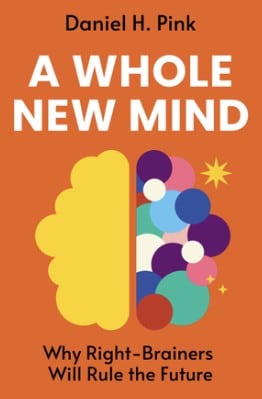
Pink argues that society is shifting from the “Information Age” to the “Conceptual Age.” Left-brain skills like logic, analysis, and efficiency are no longer enough. Globalization, automation, and abundance mean routine work can be outsourced or computerized. Pink explains that “the two hemispheres of our brains do not operate as on-off switches, one powering down as soon as the other starts lighting up.” Both sides contribute to almost everything we do. “The left hemisphere specializes in text; the right hemisphere specializes in context,” and in the Conceptual Age that contextual ability becomes more valuable. What will matter are right-brain abilities like creativity, empathy, and meaning.
Three fundamental forces are reshaping the professional landscape. Abundance, where material prosperity reduces the value of pure functionality and increases the demand for design, beauty, and personal meaning. Asia, which reflects the outsourcing of routine, left-brain tasks and raises the importance of empathy and relationship building as a competitive edge. And Automation, where computers handle analytical work with high efficiency, making uniquely human qualities like storytelling and big-picture synthesis essential. To thrive, individuals must excel at what offshore labor and algorithms cannot: creativity, empathy, and contextual understanding.
The defining capabilities of the Conceptual Age are “High Concept,” the aptitude for artistic creation, narrative construction, and pattern recognition, and “High Touch,” the capacity for empathy, emotional understanding, and forming deep connections. These human abilities cannot be outsourced or automated. They shape how individuals communicate, create meaning, and connect with others in ways machines cannot replicate.
In today’s market, where quality and price are merely “table stakes,” design has become a defining advantage. It extends beyond function and brings meaning, beauty, and emotional resonance to products and experiences. Good design creates clarity, reduces friction, and makes ideas feel coherent, engaging, and memorable.
As cognitive scientist Roger C. Schank explains, “Humans are not ideally set up to understand logic; they are ideally set up to understand stories.” Facts may inform, but stories persuade and endure because they supply context, meaning, and memory. Story transforms information into something people can relate to, remember, and act upon.
Symphony is the ability to see the larger pattern, connect ideas, and bring different elements together into a unified whole. It prioritizes integration and coherence rather than isolated parts. This aptitude allows individuals to see relationships, find patterns, and create something greater than the sum of its components.
Empathy allows people to understand and connect with others on an emotional level. It is a competitive advantage in communication, leadership, collaboration, and life. It deepens human connection and improves how people navigate conflict, relationships, and shared meaning.
Play fosters creativity, resilience, and connection. Humor, games, and lightness unlock innovation and reduce stress. Play keeps people flexible, restores perspective, and prevents work and life from becoming overly rigid or burdensome.
In an age of abundance, people increasingly search for purpose. Spirituality, fulfillment, and legacy become central concerns. Meaning-making helps individuals shape a life that feels coherent and emotionally rich rather than defined solely by achievement or accumulation.
Daniel Pink’s A Whole New Mind argues that society is shifting from the Information Age into the Conceptual Age, a period shaped by abundance, globalization, and automation. As prosperity grows and high-quality goods become widely available, technical skill and efficiency are no longer enough to stand out. Routine knowledge work can be outsourced, and computers increasingly handle repetitive and analytic tasks. The abilities that become most valuable are those rooted in creativity, empathy, big-picture thinking, and purpose.
Pink emphasizes that the two sides of the brain are always working together, yet each contributes differently. The left side excels at detail and logic, while the right side provides context, creativity, and holistic understanding. The Conceptual Age rewards those who can blend these strengths but leans heavily on right-brain aptitudes.
He identifies six core abilities that define success in this era. Design highlights the need for experiences that are emotionally engaging and aesthetically meaningful. Story shows how narrative helps people understand, remember, and connect with ideas. Symphony captures big-picture integration and pattern recognition. Empathy reflects emotional understanding and human connection. Play underscores the value of humor and creativity. Meaning points to the search for purpose and fulfillment.
Pink concludes by encouraging readers to cultivate these abilities intentionally. They are not luxuries but practical tools for navigating a world where human insight, creativity, and connection matter more than ever. Together, these aptitudes help individuals create richer, more purposeful, and more imaginative lives.